
Determined Runners, by Justin Lagat
I first published this book, Determined Runners, in 2015 on an online eBook platform. After a while, I got some sales reported, then a cheque was sent through the mail, but Kenyan Banks refused to cash it for me. I don’t know whether it was the teller’s incompetence or bank policy. From then on, I changed my address and stopped getting the cheques for the last ten years. Then I got an email reminding me to rent the platform to keep my eBooks there. The only better option for me, I figured, was to unpublish all my eBooks there. It didn’t make sense to pay when I was not getting anything in return, despite sales being reported.
However, because a lot of work went into publishing these books, I am creating some copies here on my website for my fans to read.

Acknowledgement
I would like to thank the people who made it possible for me to write this book. First are my parents, who took good care of me while I was young; my friend, Julie Larson, of Storystar.com, who encouraged, gave me hope and guided me to become a better writer after reading some of my short stories on her web site; Larry Eder, of Running Network, who believed in me and has given me the opportunity to write frequently for RunBlogRun which has resulted in my getting to meet many Kenyan runners and gaining more knowledge in running and writing.
There are so many other people to thank, including the great runners who have shared their experiences with me, welcomed me for multiple interviews, and trained with me in the same groups. To mention but a few, they are: Wilson Kiprop, Eliud Kipchoge, Asbel Kiprop, Mary Keitany,Geoffrey Mutai and Zane Robertson of New Zealand
Dedication
I dedicate this book to my dear wife, Winnie Chepkorir and my first born daughter, Berlynn Jerotich. They are the ones who motivate me to always work harder and aim for the best in life.
“To give anything less than your best is to sacrifice the gift,” – Steve Prefontaine
Contents
- Introduction
- Why Kenyans are great runners
- How Kenyan runners go for their long runs
- Individual versus camp training in Kenya
- Training in Kaptagat, Eldoret
- State of track facilities in Kenya, used by the Determined Runners
- Foreign athletes training in Kenya
- Kenya’s dominance in long and middle distance running
- Determined Runners’ efforts to fight doping
- About the Author
Introduction
Running, especially long distance, is one of the most challenging sports in the world. Besides taking many years of training, it also needs maximum perseverance, dedication, discipline and daily hard work on the part of the athlete in order for them to finally get to shine.
Perhaps that is what defines and separates the Kenyan athletes from the rest. Once they decide to pursue a goal – running for this case – nothing will stop them until they achieve it. Their strong determinations see them through hard daily workouts, waking up early in cold mornings to run, injuries, skeptics, taunting long runs and other strenuous exercises, among other challenges.
Not only are Kenyan runners determined to win, but they are also willing to give it their all. They are so hungry for success to an extent that some of them even appear to be willing to die trying as evidenced by some instances where a number of them have had to crawl to the finish line in some international marathon races. Hyvon Ng’etich crawled to the finish line at the 2015 Austin Marathon after collapsing with about 50 meters to go, but still made it to the finish line in her condition.
This first hand book, written by an athlete who has lived in the same training camps, trained and shared the same experiences with these athletes for over ten years now, may change your perceptions about these world beaters after you learn how much they sacrifice in their training.
Why Kenyans are great runners
There is an influx of tourists coming to Kenya usually from November to February every year. Most of them are sports tourists seeking to train with and like the Kenyans on the high altitudes of the Rift Valley regions, hoping that by the time they go back to their countries they will notice a big difference in their running. One thing these foreign runners get to learn and experience once they are here in Kenya is that all they really needed was just to train harder than they had been doing.
It is not automatic that foreigners who come to Kenya and train just like Kenyans are able to compete like them and become as competitive too. Apparently, it is not merely a decision to train hard that pushes Kenyans to train as hard as they do. It is a strong need to succeed in their lives, which is ingrained in their subconscious minds even when they are asleep. Here are some reasons why it may be hard for foreigners coming to Kenya to train as hard and become as successful with their running by simply shifting their training bases to Kenya.
First of all, for most Kenyans running is the only option to get out of poverty. One common phrase I have heard from a number of athletes at various camps is; “it is better to die trying to earn a living than to die of hunger.” It is often said that when one wants so much to succeed, as much as they need to breathe, then they will surely succeed. The same can be said of many Kenyan runners who see running as the only way to earn a living; buy a piece of land to live on, build a house, marry a wife, educate their children and do some developments. A foreigner who can afford a trip to and a holiday in Kenya definitely has other means to earn a living.
Second, Peer pressure. Most Kenyan runners are personal friends to Kenyan champions, and think, if they could win, why not me? Besides these friends being their living testimonies as to what they can achieve when they work as hard as them, there is also the element of wanting to be as successful as them in order to maintain their friendships and remain in the same caliber. You can imagine when a friend builds a nice house, or when he buys something new, how his friends would, in a healthy competition, want to do something as impressive or even better too.
Third, the world believes in them. It is not a secret that in every part of the world, when a marathon is organized and a name of a Kenyan athlete is seen on the start list, the rest of the competitors get nervous. This fact gives them great morale while training and running in competitions. It also works to their advantage in that the rest of the competitors in a race will allow them to control the pace believing that they know the right pace.
Fourth, “hard” means a different thing to them. They often interchange this word with the word “suicide”. For example, you will often hear them talking about a program of a day being “1 hour 10 minutes suicide.” Hard is one word that is often used in relativity. It may mean a different thing to different people and what is hard for some may be easier for others. For many Kenyan athletes whose lives have all along been hard, the degree of their hard training will definitely be different. Their normal daily activities may have included working as laborers on the farms outside in the scorching sun for a whole day, or walking for distances of over ten kilometers daily.
Five, the society has big expectations from them. Most Kenyan athletes do not run for physical fitness, or for fun. Once one starts running, he/she has to win a race at one time or else the society will keep ridiculing him that he is, or has wasted, his time training in vain. He has to prove that he did the right thing by beginning to train.
For foreign athletes out there, next time you plan to visit Kenya to train for your big race, note that the environment and high altitudes alone may not help if you do not have a strong desire in your mind to win, and a deeply ingrained hunger to succeed in your training no matter how hard to going gets.
I once asked Eliud Kipchoge, the 2003 world champion, besides being the recent winner of London, Chicago, Rotterdam and Hamburg marathons, what he thinks has enabled him to remain at the top of the world in running for such a long time and this is what he had to say. “Discipline summarizes everything. I took up running seriously as my profession. I remained disciplined not only in matters to do with running, but in life generally. It involved making sacrifices and foregoing other pleasures that could interfere with my profession.”
How Kenyan runners go for their long runs
Where there is a will; there is a way. Not all Kenyan athletes have vehicles to use in their long runs, but they still find ways to do that. Below are four typical ways in which most of the Kenyan athletes do their long runs.
Firstly, there are a number of well established athletic managements in the country who have some organized camps where their athletes do their training programs in large groups. These managements include the Gianni Demadonna and Dr. Rosa and Associates, among others. Athletes in these groups have pickup trucks that take them for their long runs where water is supplied in bottles after every five kilometers and the coaches are in the vehicle to update them on their pace schedules as they run. The vehicles also help carry athletes who give up before the end of the long run. It is the best way to go for a long run, but not all athletes in Kenya get this privilege.
Secondly, some athletes who are financially well off but are not in any of the big groups, either because they prefer to be so, or because they are in managements that have few athletes in the country, also get to enjoy their long runs because they have personal vehicles to take them individually. Some can hire a driver while others can have their spouses drive and give them water on their runs. This is the most flexible group in that athletes can easily travel to their desired place of training at their convenient time. The athletes can finish their long run anywhere and visit a restaurant for refreshments without worrying so much about the inconveniences that can be found in the larger groups.
Thirdly, most Kenyan athletes do not own vehicles and have to find a way to train hard in order to get recognition in this competitive sport, and the lack of vehicle to use during the long runs does not stop them. One or two athletes may hire a motorcycle rider to carry water for them and if the rider happens to be a coach, then the better for them.
Fourthly, even without any vehicle to use, many other Kenyan athletes have devised ways to go for their long runs that exceed 38km. They chart a route that start and end near to their residences. Also, for the first one hour into their long runs, they carry small plastic bottles or bags of water, clenched in their fists, in which they will drink the water and discard them before the pace picks up. But with the fact that most of the long runs start early in the morning when it is chilly, holding the water bottles while at the same time wearing light clothing fit for a long run is not a nice experience. The only advantage with this kind of long run is that the athletes have to finish it because there are no vehicles to hop into when one feels some discomfort. One gets to train mentally to finish a race.
Almost each and every seasoned Kenyan athlete has had to go for a long run using each of the above methods at some point in their career. In all these long runs, it is always advisable to put some money in your pockets just in case of anything. You can get lost, injured, or if in a group of professional athletes from the big camps may be left behind very early in the run and the driver fails to notice you. If it is a 45km long run for example, then you definitely will find it hard to get back to camp on your own, especially if the vehicles had ferried the athletes to do the long run in a place far from the camp, say some other 40km away
Individual versus camp training in Kenya
Ten years ago in Kenya, when an athlete got lucky to be enrolled into a training camp, it meant a lot for him, or her. It was easier then to get races, and there was also enough sponsorship in the camp to ensure that the athletes lacked nothing for their upkeep. With time, these camps have begun to suffer from mismanagement, lack of enough funding, athletes changing managements and poor public relations. This has ended up in athletes preferring to train individually at their own destinations of choice, or with smaller groups.
A number of athletes have moved out of their usual training camps of late and joined individual training groups.
The national training camps that are always set up a month or two before major championships are also not being left out of these grumblings, with some athletes always wishing they would be left to train at their own places of choice, with their coaches, when they make the team to represent the country.
One of the athletes who once expressed that wish to me is Geoffrey Mutai who said that the best place he has ever found to suit his training is at Kapng’tuny, and that his performance went down a little when he went to train in Embu with the national team to represent the country at the world cross country championships in Punta Umbria. I also spoke with Brother Colm O’Connell when Rudisha made the team to the world championships in 2013 and he told me that he would have preferred if Rudisha was left to train with him for a little more time before joining the team to Daegu.
Some of the athletes I approached to shed a light as to why they are leaving their big camps did not wish to share their experiences in a personal way, but preferred to cite “pressure” in a more general way. Most seeming to have a problem with the way they are at times being treated like high school students with fixed timetables, the a bell being rung for meal times, having to seek permission from someone when he/she has to attend to personal businesses, and other rules and regulations that have to be adhered to while in these camps.
Back in 2007, when I was in Dr. Rosa’s Kapsait Nike Athletics training camp in Marakwet, it was only one man – a veteran athlete called Erick Kimaiyo, two times Honolulu Marathon champion (1996 and 1997) who served as the camp director and a coach as well, who knew the training program for the day and would wait until we were all assembled at the starting point every morning before issuing it. Things have changed today in that athletes now have the program for the whole week or even the whole month in advance and can decide to follow it anywhere and not necessarily be at the camp to do that. This new open information has enabled most athletes to choose to train anywhere they like, so long as they are following the program.
Of late, most athletes in the big camps have been complaining of being kept in these camps for a whole year without being offered chances to go out for races. If they were out of these camps, perhaps they would be in a better position to meet other agents who would enter and sponsor them to go out and race. Looking closely at this problem, one would wonder whether this isn’t some strategy from the big managers to keep upcoming athletes from getting accessed by other agents and getting them to compete against their athletes in big races abroad. Just an assumption, because I cannot get it why a management would take up athletes who do well in local races and accommodate them for over a year without scheduling them to go out and race.
Another thing that affected some training camps is their closeness to social amenities and good track to train. To travel from the Kapsait Nike camp in Marakwet for speed workouts in the lower altitudes around Eldoret was always a two days’ trip. With time, it became more expensive for the camp to do all these trips and the upcoming athletes were asked to chip in some finances to help sponsor the camp. Most of us had no money and after we left, it did not take long before the big athletes also followed us out of the camp. Dr. Rosa withdrew his sponsorship for the camp and built another one now in Kaptagat, which is closer to Eldoret town, and this one seems to be faring well. I spoke to one professional athlete who was at the camp in Marakwet and is now a resident of the new camp and she tells me they have much more freedom here and she can choose to be in or out of the camp whenever she likes. It looks like she has got no “pressure” herself.
To counter the trend in some camps, an informer was telling me that the boarding facilities would soon be done away with in one such camp and athletes will have to arrange for their own accommodations nearby and only attend the camp for official meetings and group workouts. It looks like it may be a good way to curb the falling away of athletes.
To me, camps are an integral part of the success of runners, especially for the upcoming ones who do not have vehicles to take them for long runs and coaches to monitor their progress. Perhaps the only thing to be taken care of is how the athletes should be treated so that they do not feel that they are being pressurized, which may be a very difficult thing to do since every institution ought to have rules and regulations in order for it to run well. However rules should never become more important than people, so there should always be room for flexibility, and the athletes’ needs and interests should be given due consideration at every opportunity. It is not my place nor in my power to change how things are done, but perhaps this should just serve as food for thought to camp directors.
Another thing to add here is that there are many characters in the large training camps that make running fun, most of the time. I remember in 2011, David Tarus, famously referred to as “Big Engine” in the Kenyan athletics fraternity, a name he got after a great performance he exhibited at the Sotokoto Half Marathon in Nairobi in 2009 was part of the group I trained with at the Gianni Demadonna’s camp in Iten and I still remember some incidences when he made running fun.
One was while he was seemingly typing a text message on his phone while we were in the middle of a tempo run with most of the athletes asking him how he could manage to do that in such a hard run. It was not until his phone began playing some music did we realize that he had not actually been composing a message, but had all along been just trying to hit the right key pad to get the music playing!
Another incident was when we had travelled in the camp’s pickup truck to some place to begin a long run at around 5am one cold morning. We were beginning to shiver in the cold waiting for some other athletes to arrive in another vehicle from a different camp when he suddenly cranked up the volume of the truck’s music system, moved to the front of the car’s headlamps and started dancing in a very funny way as the rest of us formed a circle around him to get amused. He was dancing like a cartoon.
Training in Kaptagat, Eldoret
Having trained for over ten years at various places across the Rift Valley region in Kenya, for an average of one year at every place, I feel that I can comprehensively name the best place to train, but the only problem is that this will depend on the preference of an individual wishing to train. From Kapsait in Marakwet, to Kapseret and Eldoret town in Uasin Gishu, to Mosoriot and Nandi hills in Nandi, Iten, and Kaptagat in Keiyo, different athletes have varied views regarding the best places for them to train here in Kenya.
A lot has been said about Iten, so I will focus on another destination here.
Kaptagat, located about 16 kilometers East of Eldoret town, at an altitude of 2400m, is one of the best places to train and scores of athletes blaze the trails here each morning, especially at the famous Kaptagat forest. Some are natives, others rent houses around the shopping centers here namely Strawbag, Kaptagat, Chop and Chirchir centers, while others reside in training camps that include Ricky Sim’s Pace Management, Dr. Rosa and Associate’s training camp that was opened last year, The Global Sports Camp, Complete Sports Athletics Training Camp and Chepkero Athletics Club, among others.
The highest number of individual athletes lives in Strawbag, where I also rent my house close to Leornard Komon’s, the 10km and 15km world record holder and other bigwigs that include Sammy Kitwara, the fifth fastest half marathon runner in history and Kenneth Kipkemboi, the 10,000m African champion. But, although we all live close to each other, there are different training groups and each athlete is free to choose which one to join every morning.
One advantage of this place is that during a rainy season, it is still possible to train on some of the rough roads here any time, just like in Kapsait and Nandi Hills. This is almost impossible in the other places where athletes would have to travel to other destinations for their runs or wait for the ground to dry up. Here, even if you may not be sure of the right roads to use on this occasion, there is always a less busy tarmac road across the centers always in handy as another option to ensure that you will never find any excuse to miss your training.
Nobody paints a more vivid picture about Kaptagat being the best place to train than Stanley Kirwa, the winner of Pinang Bridge half marathon, among other road races in Asia. He has in the past trained in Nyahururu, Iten, Kapsabet and Kiganjo since 2001. But, the moment he came to train here in 2009, he found it an ideal place and now says that he is not thinking of going anywhere else in the future, in fact, he is planning to buy a piece of land and live here indefinitely .
“The best thing about Strawbag (Kaptagat) is that you can easily move to a lower altitude for speed works as it is nearer to Eldoret where one can go for track workouts, while at the same time, it also offers the best altitude training when you move up a little from here (towards the East)”, says the athlete, adding that the roads here are also a bit soft compared to the ones he had been using in Nyahururu and thinks that one rarely gets an injury while training in Kaptagat.
Because of lack of enough houses here, most athletes prefer to live in Eldoret town and drive up here for their morning runs every day, although, this happens mostly with the well established athletes who have enough money and private vehicles to daily drive to and fro. Most of the time, I find a private bus belonging to the International Olympic Committee’s (IOC) training camp parked somewhere around Kaptagat forest. The IOC camp itself is located close to Eldoret town.
Kaptagat is perhaps the second biggest source of international athletes, after Iten. Some athletes who are training here include Stephen Kiprotich, the 2012 Olympic gold medalist from Uganda; Eliud Kipchoge, Moses Kipsiro (Uganda), Emanuel Mutai, Micah Kogo, Vivian Cheruiyot, Hellen Obiri, Leornard Komon, Mark Kiptoo, Abraham Chepkirwok (Uganda), Joseph Ebuya and Job Kinyor; the list is endless. Also, there are the others who live in Eldoret, but frequent here.
If only there were enough houses, Kaptagat would certainly have emerged as the world’s leading destination for runners to train. But, looking into the future, the popularity of Kaptagat will continue to rise rapidly. Many elite athletes right now continue to shift their training bases here.
State of track facilities in Kenya, used by the Determined Runners
In the recent past, while Kenyan athletes have been preparing for the World and Olympic Championships that usually happen around the month of August each time, rainy conditions have always been interrupting their training. There has never been a good track facility fit for these athletes to train around Eldoret until recently when Lornah Kiplagat opened a new tartan track in Iten and the Kipchoge Keino was also refurbished in Eldoret to become an all weather track.
Before 2014, athletes have had to wait for the track facility at the University of Eldoret (Chepkoilel) to dry up so that they could get to train on it at around mid-day when it would be less muddy. Other athletes would prefer to do their speed workouts on the rough roads instead, as they would easily find a portion of the road that was better off than the tracks around here, only that it was often hard to measure accurate distances on these roads.
I remember some incidences in 2013 when I used to train in Eldoret and lived about eleven kilometers from the University of Eldoret. One Tuesday, I called one member of the group I was training in to ask about the time to meet on the track of which he replied that they were considering delaying it by an hour from the usual starting time to allow the track some time to get better.
It always took me an average of 50 minutes to jog to the track, and so I had to leave my phone in the house and start jogging in order to arrive there earlier than everyone else. I arrived there when almost half of the group, having not heard about the intended delay of time, was already there. Also present was a group of marathon runners who would at times wait for us to start running around the track to make it dryer before beginning their workouts. On this day, we were not in any hurry and so they ended up starting their workouts of 1km repetitions of 2:45 minutes and 200m jogging as their recovery. With their training shoes stepping repeatedly on the track, it became dryer and we were lucky to begin our training when it was already better.
Not all the members from my group turned up. I was later to find a missed call when I returned to my house from the same athlete I had called earlier as he had tried to inform me that they had decided to do a fartlek on the road instead. The rest of us who had turned up did 400m repetitions. It was not only the average athletes who are being affected by these conditions. I remember David Rudisha also turned up while we were in the middle of our training and he, with Job Kinyor, did a few 300m workouts as well. I am sure he was careful not to run his maximum effort as anyone could have easily skidded and fell in such conditions
The speed workouts for Thursday that same week were the most affected. Out of the usual 40 athletes, only five of us turned up. It had rained the whole night and the sky was still covered with clouds and was drizzling slightly at around 10:30am as I set out to the track. It was mere guesswork as to what could happen in the next ten minutes and I had taken some money in my pockets to board a vehicle and head back in case there was a downpour before I reached the track. But, fortunately it began to clear after some time. At the track were two foreign athletes doing 200m repetitions on one side of the track where they were running to and fro in order to avoid the other side which was too muddy.
After waiting for a while, we also decided to do an alternation of 200m and 150m intervals ten times on the same side of the field. Contrary to our expectations, it ended up being one of the best workouts I will live to remember. My colleagues said the same, but I could only say it did work better for me because I was the only long distance athlete in the group and managing to keep the gap with them was an experience I have never had in a long time. I still remember alighting from a vehicle I had boarded after the work out and for a moment, my legs refused to move, but I could only laugh at myself because I knew I had trained to the maximum. I could not help but feel sorry for the more than 80% of the other Kenyan athletes who probably failed to do their speed work on this particular day due to the lack of a good track.
Nothing could be done then by athletes about the rainy conditions and muddy roads in the country, but a time for a good track with drainage systems to ensure athletes can train on it throughout the year in Eldoret has finally come. Many Kenyan athletes from the region have been shifting to road running early in their careers due to the then poor states of the track, but now that there are two tartan tracks in this region, this trend might change and the dominance of Kenyans in road races will soon be replicated on track events too.
Foreign athletes training in Kenya
In 2014, Mo Farah, like many other top international athletes does, arrived in Kenya to intensify his training ahead of his London Marathon debut in April. His arrival was greeted with excitements among Kenyan athletes who have come to respect him, even terming him as ‘lion-hearted’ for the fact that he trains with Kenyans the Kenyan way. He is one of the athletes who believe in the philosophy of training hard and winning easy, which has been adopted by many Kenyan runners.
However, safe for Zane and Jake Robertson from New Zealand, most other international athletes do not usually take up the challenge of competing with, and trying to beat Kenyan athletes in their home ground. For the number of times that Mo Farah has come to train in Iten, he too has not been taking up the challenge to compete with Kenyans in their local competitions. It is my believe that if coming to train in Kenya helps him improve his performances in international competitions abroad, then racing with Kenyans in their local competitions here will definitely be good for them. After all, the Kenyan athletes they will be lining up against in big competitions abroad are also doing a number of local races as part of their preparations.
There are many great local competitions happening in Kenya, which I think will be perfect for foreign runners in the country to participate in. The first one is the Nike Discovery Cross Country in Eldoret which usually happen every January. Many Kenyan elite marathon runners usually grace this meeting and whoever takes the podium position here will most likely win the world major marathon title later in the year. Dennis Kimetto took second position in 2013 and went ahead to win two major city marathons and lead in the WMM points. Geoffrey Mutai also took the second position in 2012 and went ahead to win the Berlin marathon and the WMM title too.
In February, Eldoret Nike Discovery half marathon takes place also on the streets of Eldoret town. This event is organized by Nike International and Dr. Rosa Associates and is sure to assemble some of the best marathon runners in Kenya. Peter Some won this race in 2013 before proceeding to win the Paris Marathon.
Another great race for foreign athletes to try while in the country is the Kenyan National Cross Country Championships which usually happen in mid February in Nairobi.
There is only so much for foreign athletes to gain if they would dare race in the local competitions in Kenya. If they win, they will be respected more for beating Kenyans in their own soil. Zane Robertson of New Zealand just did that at a local competition and he made news across the world. Soon after, his confidence improved and he soon started running successfully in big races internationally. Winning in Kenya became one of the special moments for him.
Many Kenyan athletes know that running a competitive race here on higher altitudes will eventually help them run faster and easier while competing at lower altitudes in Europe. And, even if they may end up being beaten here, no one will take it seriously because it would just be part of their training. Athletes like Ezekiel Kemboi are always beaten in local races here in Kenya, but not in the big international events.
It is my hope that I will see more foreign athletes coming to train in Kenya take up the challenge to race against Kenyans in the local competitions while here. It will be good for them and other local athletes will see it as an honor and privilege to race against them
.
Kenya’s dominance in long and middle distance running
800m to 3000m are considered to be the middle distance events in running. Events longer than 3,000 meters are long distance events. The most common long distance races are the 5000 meters, the 10,000 meters, and the marathon, which does not take place on a track but on paved roads over a course of 42 .195km.
Marathon running event is traditionally the longest race that is usually included in world’s major track and field competitions like the Olympic Games, the IAAF world championships, the Commonwealth Games and African Championships, among others. Marathons have become increasingly popular around the world, and the larger events—such as races held in Boston, Massachusetts; London, England; Berlin, Germany; and New York City—attract thousands of runners and spectators annually.
The African nations of Kenya and Ethiopia have emerged as the leading producers of great male marathoners. Ethiopia’s tradition goes back to Bikila in the 1960s, while Kenya first became a force beginning in 1988 when Ibrahim Hussein captured the first of his three Boston Marathon titles. Kenyan runners—such as Hussein, Joseph Chebet, John Kagwe, Cosmas Ndeti, and Moses Tanui—won every men’s Boston Marathon but one from 1991 to 2004, along with five New York City Marathons from 1997 to 2004. Some experts attribute this trend to the higher elevations at which these runners train in their home countries. Top marathoners from other countries have responded by also training extensively at high elevations.
Runners from Kenya have run nine of the 10 fastest times ever for the marathon. They have also been among the most consistent winners in the World Marathon Majors; Boston, New York, London, Berlin, Chicago and Tokyo.
Men’s 100 fastest times of all time in marathon as of June 2015:
1. 2:02:57 Dennis Kimetto KEN 22.04.84 Berlin 28.09.2014
2. 2:03:02a Geoffrey Mutai KEN 07.10.81 Boston 18.04.2011
3. 2:03:06a Moses Mosop KEN 17.07.85 Boston 18.04.2011
4. 2:03:13 Emmanuel Mutai KEN 12.10.84 Berlin 28.09.2014
5. 2:03:23 Wilson Kipsang KEN 15.03.82 Berlin 29.09.2013
Kiprotich
6. 2:03:38 Patrick Makau KEN 02.03.85 Berlin 25.09.2011
7. 2:03:42 Wilson Kipsang KEN 15.03.82 Frankfurt 30.10.2011
Kiprotch
8. 2:03:45 Dennis Kimetto KEN 22.04.84 Chicago 13.10.2013
9. 2:03:52 Emmanuel Mutai KEN 12.10.84 Chicago 13.10.2013
10. 2:03:59 Haile Gebrselassie ETH 18.04.73 Berlin 28.09.2008
11. 2:04:05 Eliud Kipchoge KEN 05.11.84 Berlin 29.09.2013
12. 2:04:11 Eliud Kipchoge KEN 05.11.84 Chicago 12.10.2014
13. 2:04:15 Geoffrey Mutai KEN 07.10.81 Berlin 30.09.2012
14. 2:04:16 Dennis Kimetto KEN 22.04.84 Berlin 30.09.2012
15. 2:04:23 Ayele Absehero ETH 28.12.90 Dubai 27.01.2012
16. 2:04:26 Haile Gebrselassie ETH 18.04.73 Berlin 30.09.2007
17. 2:04:27 Duncan KEN 25.04.78 Rotterdam 05.04.2009
Kibet Kipkemboi
17. 2:04:27 James Kipsang KEN 28.02.83 Rotterdam 05.04.2009
Kwambai
19. 2:04:28 Sammy Kirop KEN 26.11.86 Chicago 12.10.2014
Kitwara
20. 2:04:29 Wilson Kipsang KEN 15.03.82 London 13.04.201
Kiprotich
21. 2:04:32 Tesgaye ETH 15.06.95 Dubai 24.01.2014
Mekonnen Asefa
21. 2:04:32 Dickson Chumba KEN 27.10.86 Chicago 12.10.2014
23. 2:04:38 Tsegay Kebede ETH 15.01.87 Chicago 07.10.2012
24. 2:04:40 Emmanuel Mutai KEN 12.10.84 London 17.04.2011
25. 2:04:42 Eliud Kipchoge KEN 05.11.84 London 26.04.2015
26. 2:04:44 Wilson Kipsang KEN 15.03.82 London 22.04.2012
Kiprotich
27. 2:04:45 Lelisa Desisa ETH 14.01.90 Dubai 25.01.2013
Benti
28. 2:04:47 Wilson Kipsang KEN 15.03.82 London 26.04.2015
Kiprotich
29. 2:04:48 Patrick Makau KEN 02.03.85 Rotterdam 11.04.2010
29. 2:04:48 Yemane Adhane ETH 08.04.85 Rotterdam 15.04.2012
29. 2:04:48 Berhanu Shiferaw ETH 31.05.93 Dubai 25.01.2013
32. 2:04:49 Tadesse Tola ETH 31.10.87 Dubai 25.01.2013
33. 2:04:50 Dino Sefer ETH 28.05.88 Dubai 27.01.2012
33. 2:04:50 Getu Feleke ETH 28.11.86 Rotterdam 15.04.2012
35. 2:04:52 Feyisa Lelisa ETH 01.02.90 Chicago 07.10.2012
35. 2:04:52 Endeshaw ETH 18.03.88 Dubai 25.01.2013
Negesse
37. 2:04:53 Haile Gebrselassie ETH 18.04.73 Dubai 18.01.2008
37. 2:04:53a Gebre-egziabher ETH 10.09.84 Boston 18.04.2011
Gebremariam
37. 2:04:53 Bernard Koech KEN 31.01.88 Dubai 25.01.2013
40. 2:04:54 Markos Geneti ETH 30.05.84 Dubai 27.01.2012
41. 2:04:55 Paul Tergat KEN 17.06.69 Berlin 28.09.2003
41. 2:04:55 Geoffrey Mutai KEN 07.10.81 Rotterdam 11.04.2010
41. 2:04:55 Stanley Biwott KEN 21.04.86 London 13.04.2014
44. 2:04:56 Sammy Korir KEN 12.12.71 Berlin 28.09.2003
44. 2:04:56 Jonathan Maiyo KEN 05.05.88 Dubai 27.01.2012
46. 2:04:57 Wilson Kipsang KEN 15.03.82 Frankfurt 31.10.201
47. 2:04:58a Ryan Hall USA 14.10.82 Boston 18.04.2011
48. 2:05:00 Eliud Kipchoge KEN 05.11.84 Rotterdam 13.04.2014
49. 2:05:03 Moses Mosop KEN 17.07.85 Rotterdam 15.04.2012
50. 2:05:04 Abel Kirui KEN 04.06.82 Rotterdam 05.04.2009
50. 2:05:04 Kenenisa Bekele ETH 13.06.82 Paris 06.04.2014
52 . 2:05:06 Geoffrey Mutai KEN 07.10.81 New York 06.11.2011
City
53. 2:05:08 Patrick Makau KEN 02.03.85 Berlin 26.09.2010
54. 2:05:10 Samuel Wanjiru KEN 10.11.86 London 26.04.2009
54. 2:05:10 Geoffrey Mutai KEN 07.10.81 Berlin 26.09.2010
54. 2:05:10 Tadesse Tola ETH 31.10.87 Dubai 27.01.2012
57. 2:05:12 Stanley Biwott KEN 21.04.86 Paris 15.04.2012
58. 2:05:13 Vincent Kipruto KEN 13.09.87 Rotterdam 11.04.2010
58. 2:05:13 Markos Geneti ETH 30.05.84 Dubai 24.01.2014
60. 2:05:15 Martin Lel KEN 29.10.78 London 13.04.2008
61. 2:05:16 Levi Matebo KEN 03.11.89 Frankfurt 30.10.2011
61. 2:05:16 Sammy Kirop KEN 26.11.86 Chicago 13.10.2013
Kitwara
63. 2:05:18 Tsegay Kebede ETH 15.01.87 Fukuoka 06.12.2009
64. 2:05:19 Tsegay Kebede ETH 15.01.87 London 25.04.2010
65. 2:05:20 Tsegay Kebede ETH 15.01.87 London 26.04.2009
66. 2:05:23 Feyisa Lelisa ETH 01.02.90 Rotterdam 11.04.2010
67. 2:05:24 Samuel Wanjiru KEN 10.11.86 London 13.04.2008
68. 2:05:25 Bado Worku ETH 22.07.88 Berlin 26.09.2010
68. 2:05:25 Albert Matebor KEN 20.12.80 Frankfurt 30.10.2011
70. 2:05:27 Jaouad Gharib MAR 22.05.72 London 26.04.2009
70. 2:05:27 Wilson Chebet KEN 07.12.85 Rotterdam 10.04.2011
70. 2:05:27 Tilahun Regessa ETH 18.01.90 Chicago 07.10.2012
73. 2:05:28 Hayle Lemi ETH Dubai 23.01.2015
74. 2:05:29 Haile ETH 18.04.73 Dubai 16.01.2009
Gebrselassie
75. 2:05:30 Abderrahim MAR 21.05.76 London 13.04.2008
Goumri
75. 2:05:30 Eliud Kipchoge KEN 05.11.84 Hamburg 21.04.2013
77. 2:05:33 Vincent Kipruto KEN 13.09.87 Rotterdam 10.04.2011
78. 2:05:36 James Kipsang KEN 28.02.83 Berlin 28.09.2008
Kwambai
78. 2:05:36 Wilson Chebet KEN 07.12.85 Amsterdam 20.10.2013
80. 2:05:37 Moses Mosop KEN 17.07.85 Chicago 09.10.2011
80. 2:05:37 Wilson Loyanai KEN 20.11.88 Seoul 18.03.2012
82. 2:05:38 Khalid USA 22.12.71 London 14.04.2002
Khannouchi
82. 2:05:38 Tilahun Regessa ETH 18.01.90 Rotterdam 14.04.2013
84. 2:05:39 Eliud Kiptanui KEN 06.06.89 Praha 09.05.2010
85. 2:05:41 Samuel Wanjiru KEN 10.11.86 Chicago 11.10.2009
85. 2:05:41 Yami Dadi ETH 82 Dubai 27.01.2012
85. 2:05:41 Wilson Chebet KEN 07.12.85 Amsterdam 21.10.2012
85. 2:05:41 Getu Feleke ETH 28.11.86 Wien 13.04.2014
89. 2:05:42 Khalid MAR 22.12.71 Chicago 24.10.1999
Khannouchi
89. 2:05:42 Shami Abdullah ETH 16.07.84 Dubai 27.01.2012
89. 2:05:42 Deressa Chisma ETH 21.11.76 Dubai 27.01.2012
89. 2:05:42 Dickson Chumba KEN 27.10.86 Tokyo 23.02.2014
93. 2:05:44 Getu Feleke ETH 28.11.86 Amsterdam 17.10.2010
94. 2:05:45 Martin Lel KEN 29.10.78 London 17.04.2011
94. 2:05:45 Patrick Makau KEN 02.03.85 London 17.04.2011
96. 2:05:46 Dickson Chumba KEN 27.10.86 Eindhoven 14.10.2012
97. 2:05:47 Vincent Kipruto KEN 13.09.87 Paris 05.04.2009
98. 2:05:48 Paul Tergat KEN 17.06.69 London 14.04.2002
98. 2:05:48 Jafred Chirchir KEN 08.08.83 Eindhoven 09.10.2011
100. 2:05:49 William Kipsang KEN 26.06.77 Rotterdam 13.04.2008
100. 2:05:49 Birhanu Girma ETH 22.11.8 Dubai 24.01.2014
100. 2:05:49 Mark Korir KEN 10.01.85 Paris 12.04.2015
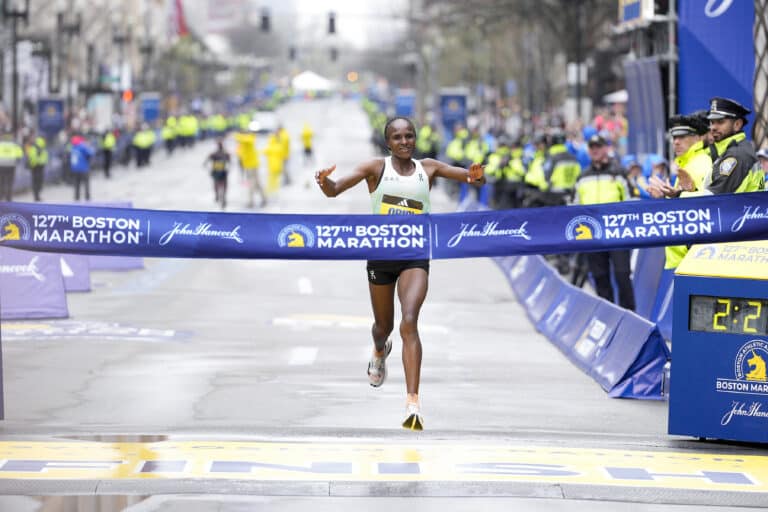
Ibrahim Hussein won the first of his three Boston Marathon victories in 1988, less than a year after winning the New York City Marathon. Hussein would have back-to-back victories at Boston in 1991-92. Kenyan men broke the tape at the Boston Marathon 20 times since 1988, including 10 times in a row from 1991 to 2000. Kenyan women have 10 victories at Boston, four of them by one woman.
The notable winners being Cosmas Ndeti, who won three in a row from 1993–95, running a course record 2:07:15 in 1994; Moses Tanui, a two time winner in 1996 and 1998; Robert Kipkoech Cheruiyot, whose four victories (2003, 2006–08) make him and Bill Rodgers the race’s only four-time winners in the men’s division; Catherine Ndereba, the only four-time winner in the women’s open division; Geoffrey Mutai, whose 2:03:02 winning time in 2011 is the fastest marathon time ever and Rita Jeptoo, who won in 2013 before the attack.
In the fall of 1987, Hussein’s win in the New York City Marathon became the first by a runner of African descent in the event. Three years later, Douglas Wakiihuri would win the race that begins in Staten Island and goes through Queens, Brooklyn and the Bronx, ending in Manhattan’s Central Park. Kenyan men won the race eight more times, and Kenyan women six in the open division. Among them were John Kagwe, winner of back-to-back titles (1997–98); Tegla Loroupe, who won in 1994 and repeated as champion the following year; Martin Lel, whose victories in New York came four years apart (2003, 2007); Geoffrey Mutai, the second fastest marathoner ever, who set a course record (2:05:06) in winning the 2011 race; Margaret Okayo, whose victories in 2001 and 2003 were course records.
Douglas Wakiihuri won the London Marathon race in 1989; it took fifteen more years before another Kenyan, Evans Rutto, would win in London again. Martin Lel has won the marathon three times in the event including setting a course record of 2:05:15 in 2008. Mary Keitany won back to back titles in 2011-12.
The Chicago Marathon was first held in 1977 and runners from Kenya have won the men’s open division 14 times, including nine in a row from 2003 to 2011.Evans Rutto won in 2003 and 2004 while the late Samuel Wanjiru won in 2009 and 2010.
Joyce Chepchumba won consecutive titles in 1998 and 1999 in the women’s open division; Catherine Ndereba won in 2000 and repeated in 2001 with a world women’s record of 2:18.47.
From 2003 to 2014, three Kenyan men have set world records in the Berlin Marathon, namely; Paul Tergat in 2003, Patrick Makau in 2011, Wilson Kipsang in 2013 and Dennis Kimetto in 2014. Kenyans have also won the past five Berlin Marathon races until 2014 and fourteen overall, including seven victories in a row from 1999 to 2005. Patrick Makau Musyoki won in consecutive years in 2010 and 2011, the latter in a world-record time of 2:03:38.
Tokyo Marathon is the newest of the World Marathon Majors, the first marathon was held in 2007 in which Daniel Njenga won the inaugural race in 2:09:45. Kenyan runners have won the race four times, including the 2013 champion Dennis Kimetto, who set a course record (2:06:50).
Samuel Wanjiru became the first Kenyan man to win an Olympic Gold in the marathon when he ran an Olympic Games’ record 2:06:32 at the Beijing Olympics in 2008. Douglas Wakiihuri won the country’s first marathon medal, a silver medal at the 1988 games in Seoul. Erick Wainaina won two medals, a bronze at the 1996 games in Atlanta and a silver medal at the 2000 games in Sydney.
Catherine Ndereba won consecutive silver medals in the women’s marathon in Athens 2004 and in Beijing 2008.
Kenya’s female runners have, over the last few years, also begun dominating the world’s major marathons and chances are high that they will soon begin to replicate their male counterparts in the near future. They face tough competition from countries that have produced top female marathoners in the last 20 years including Ethiopia, Germany, Italy, Japan, Mexico, and Russia. In the 1990s and early 21st century the best female marathoners included Germany’s Uta Pippig, Ethiopia’s Fatuma Roba and Japan’s Naoko Takahashi before Kenya’s Catherine Ndereba finally came up to open doors for other Kenyan female runners.
Challenges that may affect Kenya’s dominance in the near future mostly lie in the changing life-styles. Most of the traditional ways of life are quickly being replaced by modern ways of doing things. Firewood is being replaced by electricity and gas cookers. Herding cattle over vast pastoralist fields is being replaced by Zero grazing where machines also take up most of the manual work that used to be performed by herdsmen in the past. This is why the future of the Kenyan domination remains to be seen. Ways of life change with the influence of modernity. There are living rooms now, TVs, play stations and vehicles and people tend to stay indoors most of their time. Kids also no longer run to school like their parents did, but they are driven there by vehicles and motorcycles.
Kenya, and perhaps Ethiopia to some extent, is abundantly blessed with world-class runners. Even small villages and families boast of multiple standouts. It would not be a surprise to have one Olympic champion whose one of his childhood friends, his teacher, his sibling or any other close person to him is also an Olympic medalist.
Kenyan runners have always dominated the cross country running too. These races are not held during track and field meets, but many distance runners compete at cross country during the fall and winter seasons. Cross-country races take place over rough, rolling terrain with the standard distance for senior races usually being 12km. But, because of the varying conditions and sites, no world records are kept for cross-country racing.
Kenya and Ethiopia have always dominated the world cross country events since 1986 to present.
Kenyan runners have been especially dominant in all the middle and long distance races. The country produced the world’s top eight steeplechasers of 1995, the top five finishers in the 1996 Boston Marathon, and every world cross-country champion from 1986 to 1996.
In the past, before Kenyans began ruling the distance running events, it was Finland who ruled in the 1920s, Sweden in the 1940s, and England during the late 1970s and early 1980s, Kenya has taken the lead from there, and continues to do so.
Among those who helped establish the beginning of Kenya’s dominance in distance running were Kipchoge Kipkeino, the gold medalist in the 1500 meters at the 1968 Olympics and the steeplechase in 1972; Amos Biwott, who in 1968 became the first Olympian to complete the steeplechase without landing in a single water obstacle; Wilson Kiprugut Chuma, the first Kenyan to win an Olympic medal and Naphatali Temu, Kenya’s first Olympic gold medalist, among others.
The event that has been practically owned by Kenyan men on the track is the 3000m Steeplechase. It is the event that covers 3,000 meters; seven and half laps around a four hundred meter track. On each lap, runners must leap four hurdles that are 91 cm tall for men and 76 cm for women. In addition, each lap features a water jump, in which the athletes step on a barrier, then leap into a sloping, 3.7m long pool of shallow water.
Besides their mental toughness, many of Kenya’s distance runners are small and light-framed. They have natural running styles that avoid excess motion, Knee action is slight, arm movements are controlled and their strides are shorter than those used in sprinting or middle-distance running. Although fitness is essential, competing in long distance events also involves careful strategizing. Kenyan runners use a variety of techniques to outperform their opponents, from abrupt changes of pace during the race to fast finishing kicks.
Determined Runners’ efforts to fight doping
It is true that Kenyans are great middle and long distance runners. It is also encouraging to note that most of these great athletes are proud of their natural talents and are supporting efforts to clean up the sport from drug cheats. Like they have always been at the top of the world in competitions, some Kenyan athletes are expectedly also at the fore front in ensuring the sport is clean since there is so much focus on them from the rest of the world. World and Olympic champion, Asbel Kiprop has in the recent past been the one who has particularly stood up and asked fellow athletes to say no to drugs in sports, both in his personal social media accounts and while speaking to press. More athletes ought to follow his example.
Athletes are the ones that are most affected negatively when a sport is tarnished by allegations of rampant doping and vice versa when the sport is cleaned. Companies that invest in them to promote their products may either begin to lose interest in being associated with them or feel proud of them, hence impacting also on the lives of many other young and upcoming athletes who will be yearning to get contracts and sponsorship deals in future.
It is very disappointing for an athlete to work hard in order to attain a competitive time, only to face suspicions when he finally achieves it because some people are capitalizing on the few athletes that ever doped to convince others that there is no way anyone can run a sub 2:10 marathon without the help of drugs. It is actually very easy to guess the source of these false persuasions as some lovers of money (in the form of quacks, irresponsible coaches and agents) are busy devising ways to rob innocent hardworking athletes of their money. When athletes will choose to stand up together in a mission to clean the sport, I believe a big progress will be realized in the fight against doping.
Not only should the athletes be involved because they are the most affected, but also because they will be more efficient in reaching out to each other since they are always together in training camps and in venues of competitions. While I have never witnessed an athlete doping, I have unfortunately heard some who talked as though they were willing to dope if they found the means. I am glad I have been able to dissuade others from such thoughts and helped them to believe that they can achieve their goals while running clean, to feel proud and live good healthy lives in their future. It is easier for another athlete to open up and seek answers from a fellow athlete.
I believe that if more information is made available to athletes, such as the list of prohibited substances and the process of collecting and testing of samples, among other relevant information, they will begin to trust the credibility of the anti-doping agencies more and will listen less to those who will be telling them they will get away with doping. When educative materials are made available to athletes, then incidences of athletes being led to dope without their knowledge will certainly be eliminated.
There are many ways athletes can participate in ensuring that our sport is free from cheats. Being one of the many athletes who has proudly run in many races with their natural efforts and talents, this issue is one of great importance to me. I want to be part of a clean sport and for Kenyan athletes to be known throughout the world as those who can achieve greatness in our sport without the aid of drugs. I hope that prominent stakeholders, legendary athletes and influential people in this sport will all work together to achieve a greater awareness of the problem and a desire amongst all athletes in every part of the world to remain clean and compete fairly.
After helping to separate facts from myths on doping, it will then rest upon the athlete to choose whether to believe what other successful athletes who run clean tell them, or to believe a quack at some chemist somewhere, who is just interested in his/her money, to inject him with some substances that might even be still under research as to whether they are fit for human beings! After all, the quack gets his money even before one goes out to run and will not be held responsible in any way for what happens to the athlete because he certainly won’t write a receipt nor a prescription note for what he gives.
Most of the athletes who end up doping have been made to believe that everyone who does well in sports does so with the help of drugs; which is wrong. These thoughts are implanted in them by unscrupulous doctors, agents and coaches who take advantage of their innocence regarding matters to do with doping in order to benefit financially from them. This site aims to educate athletes on the dangers of doping, the measures being taken by WADA and other relevant authorities to curb it and to reassure them that most of the star athletes who are their role models are actually clean, contrary to what they have been made to believe.
I am a Kenyan athlete who has been training with fellow Kenyan athletes in various athletics training camps across the country and participating with them in long distance events since 2004. I have also worked as a sports freelance journalist since 2011 to present, covering the topic of long distance running and conducting interviews with prominent athletes, coaches and other stakeholders in the sport. I have learned a lot in the company of these athletes throughout the years and I believe that the best way to create an effective awareness campaign against doping is for the campaign to be carried out within our own athletic community.
I have created a website (http://www.kenyanathlete.com/) to address the issue of doping in the hope that greater awareness of the problem will lead to a desire among all Kenyan athletes to remain clean and compete fairly. I will be inviting prominent stakeholders, legendary athletes and influential people to make statements that discourage doping and post them in the website. I will also be posting links from WADA and IAAF that work in educating the athletes on the dangers of doping. Kenya is known the world over for producing the best middle and long distance athletes and so it is only proper that the campaign against doping among runners begin here in Kenya in order to influence the rest of the athletes in the world. If the best athletes demonstrate to the world that they are running clean, then they will be the best role models to the upcoming athletes. This platform will seek to give a voice to these great athletes so that they may be a positive influence to the young athletes who will follow their example.
Not only will this campaign be on the internet, but also with printed leaflets and word of mouth, as I and other willing athletes will carry the campaign to training camps and meeting venues.
For those few athletes who think they can dope and get away with it, I have a few thoughts for you to ponder about: If others were caught, who are you? And if you think that a four year ban is worth risking, think again. Once a cheater, you will forever remain so in the eyes of athletic fans. Also, perhaps things might change soon and we may have athletes that have ever been banned in the past and those who will be caught in future to be given a life ban. Think also about the side effects of the drugs that you will have to live with for the rest of your life. Think also about your ego and your integrity. Think about the fairness and the cleanliness of the sport. Think about the reputation of runners throughout the world. Do you wish to be the person responsible for tainting the reputation of your country and your people, or do you want to be part of a legacy of athletic and genetic greatness? The choice is yours to make.
About the Author
Justin Lagat is a Kenyan athlete who has been, and continues, training and running long distance races since 2004. His exposure to, and association with the word’s top runners has given him great insights into habits that make world beaters. He has written articles for international publications that include World Athletics, RunBlogRun, Competitor.com and Thrive Sports among others.
In this book, Justin depicts the way of life in Kenya’s athletic training camps in the Rift Valley region; the running culture in Kenya and the characters, mindsets and training methods of Kenyan runners that enable them dominate the world in long/middle distance running.